Pearson Edexcel · GCSE · Mathematics
Course version: 1MA1 · Version from Mar 2026
Geometry and measures - Properties and constructions: use conventional terms and notations: points, lines, vertices, edges, planes, parallel lines, perpendicular lines, right angles, polygons, regular polygons and polygons with reflection and/or rotation symmetries; use the standard conventions for labelling and referring to the sides and angles of triangles; draw diagrams from written description
Geometry questions reward candidates who can turn mathematical language into an exact diagram. Master the notation, marks and triangle conventions in G1 and you will avoid losing straightforward marks while building a reliable foundation for angle facts, shape properties and transformations. Use the [complete downloadable JSON guide](/home/ubuntu/study_guide/geometry_notation_and_diagrams_study_guide.json) alongside the diagrams and ten-minute audio episode.
- 12 min read
- 3 worked examples
- 6 practice questions
- 18 key terms
Try the lesson
The start of the Geometry and measures - Properties and constructions: use conventional terms and notations: points, lines, vertices, edges, planes, parallel lines, perpendicular lines, right angles, polygons, regular polygons and polygons with reflection and/or rotation symmetries; use the standard conventions for labelling and referring to the sides and angles of triangles; draw diagrams from written description lesson, made from checked teaching notes for this specification point.
Have a go first
Which of these is the correct name for a polygon with exactly 6 sides?
There is more to this lesson
The full lesson goes on to check your understanding and help you earn the marks. Create a free account to carry on, with your progress saved.
7 days Premium · Then the free plan continues · No card, no charge
Check what you remember
Read the wording for your board, then hide it and explain point in your own words. Rough notes are fine. This is a self-check, with no mark or grade.
Reference: Pearson Edexcel
An exact position with no size, usually named by a capital letter.
Study Notes
Overview
G1 is the language and diagram-reading toolkit for Pearson Edexcel GCSE Mathematics: it asks you to recognise exactly what a point, line, vertex, edge, plane, parallel line, perpendicular line, polygon and regular polygon mean, then communicate that information unambiguously. It matters because one small notation error can change the object or angle being named: in ∠ABC, B is the vertex, while in triangle ABC, side a is opposite vertex A. You will use this vocabulary to interpret a labelled diagram, add conventional marks, and turn a written description into a useful sketch or accurate drawing. These skills support later geometry, especially G3 angle facts, G4 properties of shapes, G7 transformations and G11 coordinates. Typical questions ask candidates to identify a feature, name an angle or side, complete a diagram, or draw a labelled shape from stated conditions. G1 is common to Foundation and Higher tiers: there is no Higher-only core G1 content. Precision, not artistic appearance, earns the marks: each stated fact must be visible in the correct position.
Key concepts
1. Geometry vocabulary is a precise code
A point is an exact position, usually shown by a dot and capital letter. A line is straight, has no thickness and extends indefinitely in both directions; a line segment is the finite straight part between two endpoints. A plane is a flat two-dimensional surface extending indefinitely. A vertex is a corner where sides or edges meet. An edge of a polyhedron is a line segment where two faces meet; a face is one flat surface of that solid. Do not call a corner an edge.
A polygon is a closed, two-dimensional shape made only from straight line segments. A triangle has three sides, a quadrilateral four, a pentagon five, a hexagon six, a heptagon seven, an octagon eight, a nonagon nine and a decagon ten. Regularity is a separate condition from the number of sides. A non-square rectangle has equal angles but not all equal sides; a non-square rhombus has equal sides but not all equal angles. Neither is regular. A polygon is regular only when all its sides are equal and all its interior angles are equal. Equal-looking sides on an informal drawing prove nothing unless given or marked.
Exam vocabulary test: a cube has faces, edges and vertices; a triangle drawn on paper has sides and vertices, not faces or edges.
2. Parallel, perpendicular and equality marks
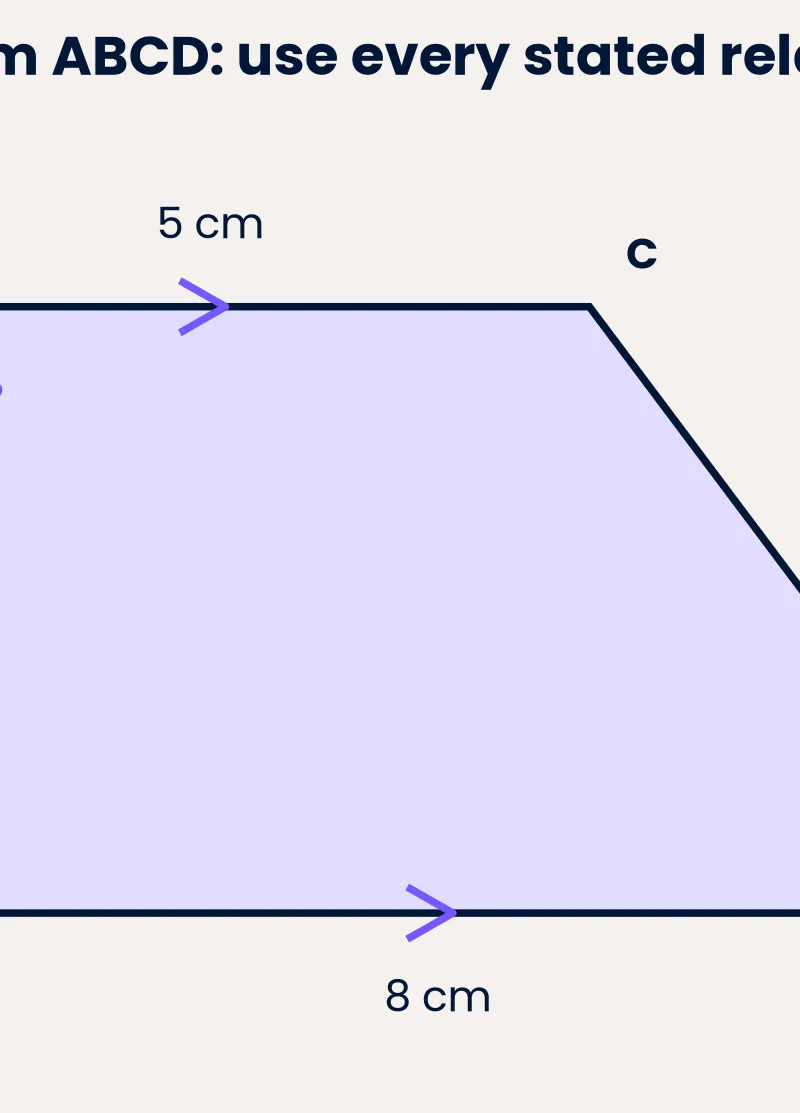
Parallel lines are coplanar lines that never meet, however far extended. Put the same arrow marking on each parallel line: one arrow on one pair, two arrows on a different pair. Perpendicular lines meet at a right angle, which is exactly 90°. Mark that fact with a small square at the intersection. Lines that simply look almost vertical and horizontal are not automatically perpendicular.
Equal lengths are shown with matching short dashes across the relevant sides. Equal angles may be shown with matching arcs. In symbols, AB ∥ CD means AB is parallel to CD; AB ⟂ BC means AB is perpendicular to BC; AB = AC means those segment lengths are equal. These conventions compress information: before calculating, translate every arrow, dash, arc and right-angle square into words. The official Pearson teaching guidance includes geometry notation, accurate ruler/protractor triangle drawing and everyday diagrams 2.
Memory check: arrows mean parallel, a tiny square means 90°, and matching dashes mean equal lengths.
3. Triangle labels and angle notation
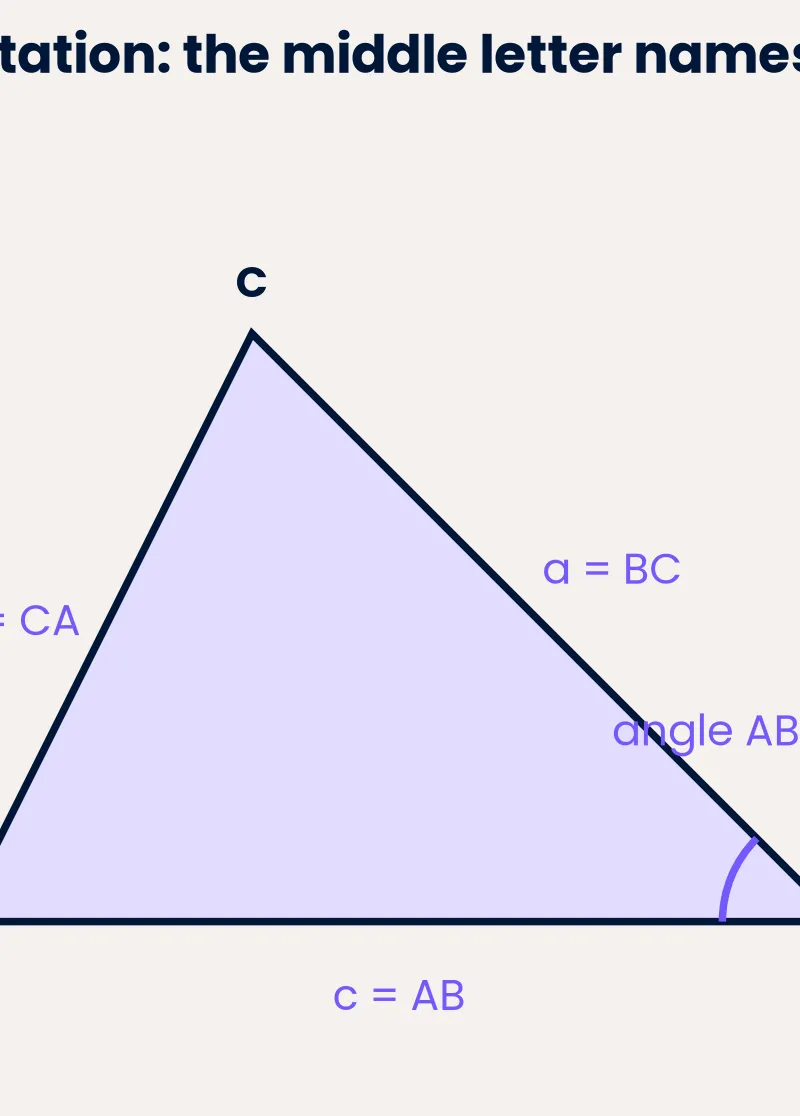
In triangle ABC, capital letters identify the vertices. Lowercase side letters are opposite their matching capital vertex: a = BC, b = CA, and c = AB. They are not placed next to the letter they match. An angle name has its vertex in the middle: ∠ABC and ∠CBA are the same angle at B, while ∠BAC is at A. When a diagram has only one angle at a vertex, “angle B” can be understood, but three-letter notation is safer where several rays meet.
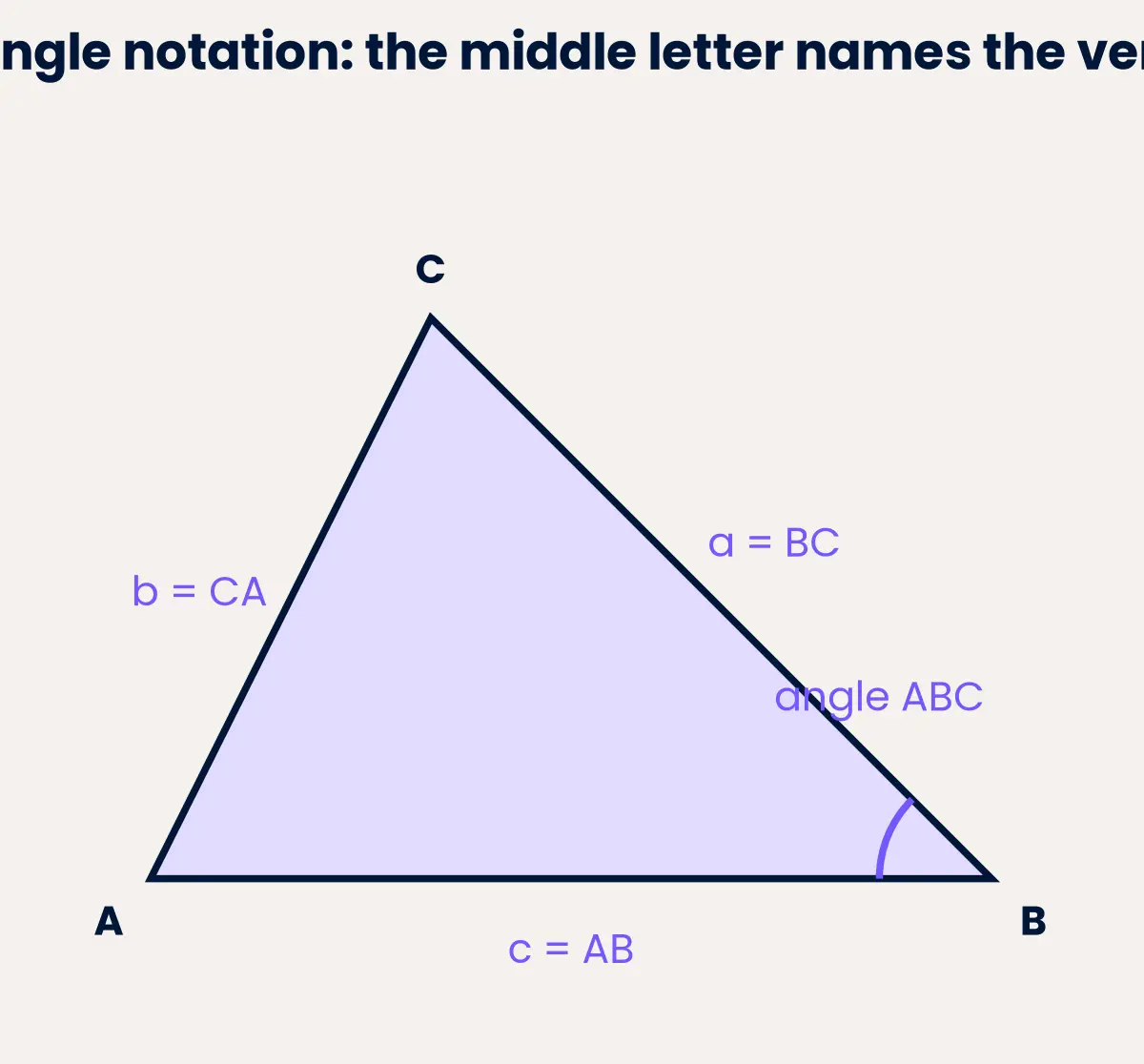
Read the diagram actively. In the pictured scalene triangle, side a is BC, so it lies opposite A; side b is CA, opposite B; side c is AB, opposite C. Scalene means all three side lengths are different. This naming convention is also useful later in trigonometry and the sine rule, but those methods are not core G1.
4. Symmetry describes shape, but is not an isolated G1 prediction
A line of reflection symmetry divides a shape into two mirror-image halves. Rotational symmetry of order greater than 1 means a shape maps onto itself after a positive turn smaller than 360°. Its order is the number of matching positions in a full turn, counting the completed 360° turn but not counting the starting position again. Every shape has at least order 1: it matches after 360°, even if no smaller positive turn works. For a regular n-sided polygon, there are n reflection lines and its rotational order is n. Reflection lines in an even-sided regular polygon pass through pairs of opposite vertices or opposite side midpoints; in an odd-sided one, each runs through a vertex and the opposite side midpoint. Order is a pure number, so it has no unit.
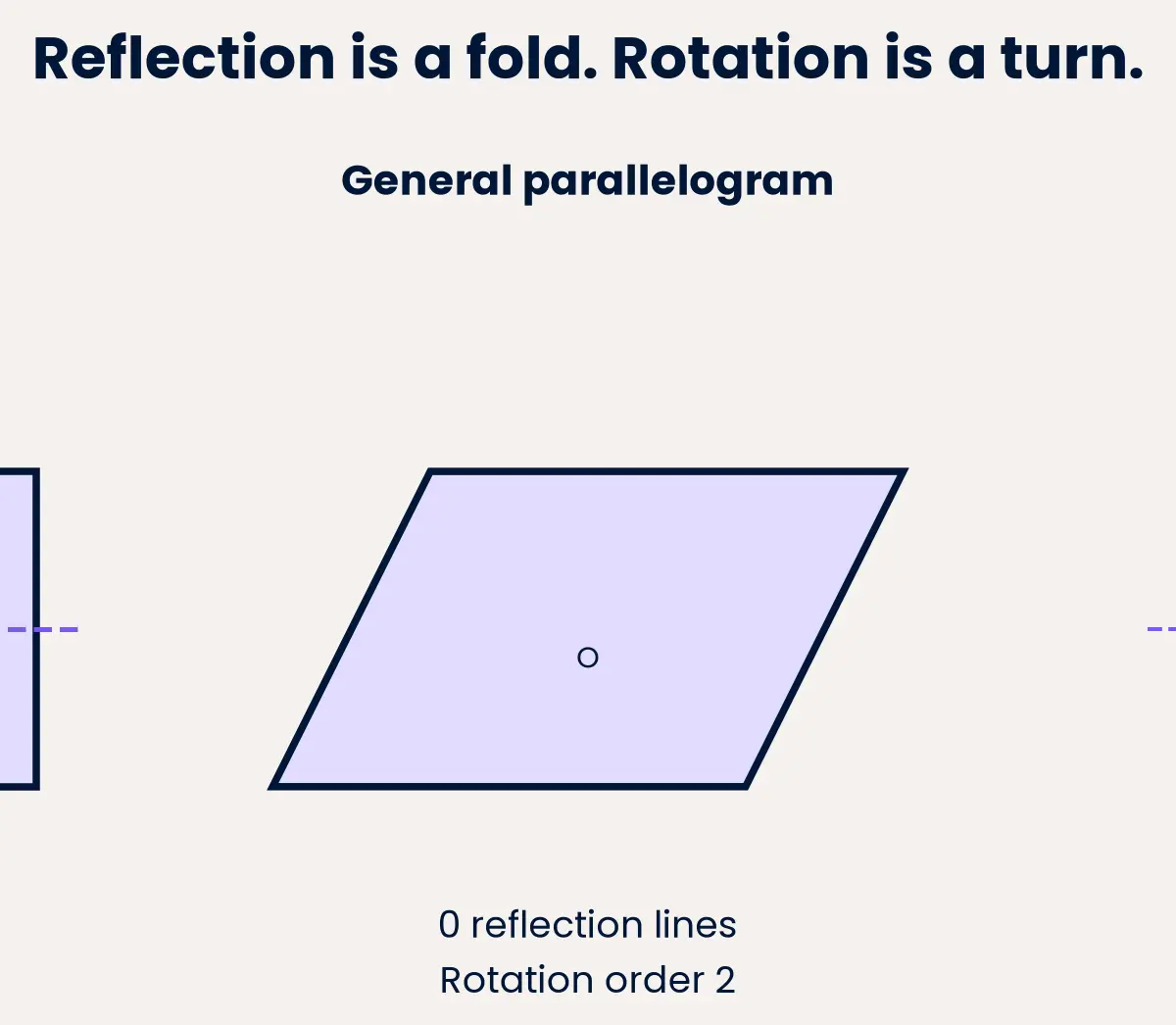
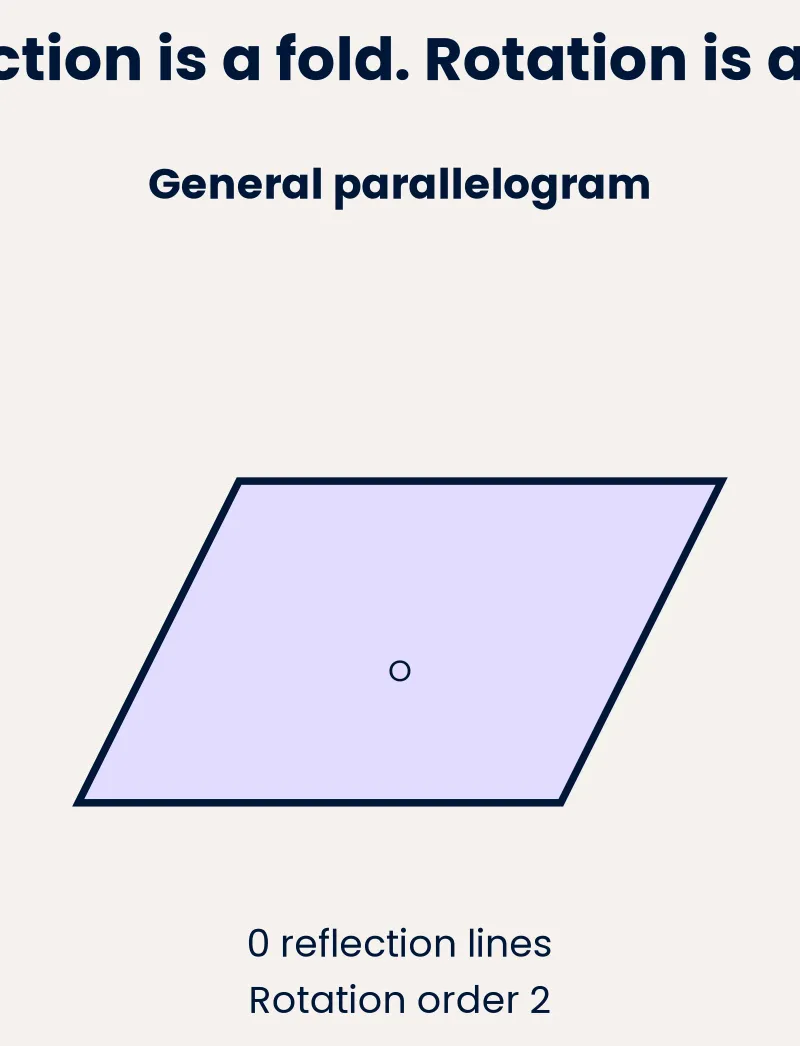
For consolidation, a non-square rectangle has two reflection lines and rotational order 2; a general parallelogram has no reflection lines and order 2; a regular hexagon has six reflection lines and order 6. However, Pearson's Issue 4 guidance says isolated questions that ask only for a number of symmetry lines or a rotation order are not expected. Use these as consolidation recall, not as predicted standalone Edexcel questions; symmetry can describe a shape and transformations are assessed under G7 2.
5. Turn a description into a markable diagram
A sketch is a clear, not necessarily measured drawing that shows required relationships. An accurate drawing is made to the stated measurements, for example with a ruler and protractor. A construction uses construction methods and instruments to create a precise geometric result. G1 may require a sketch or accurate diagram from a description; compass constructions belong to G2, not this core content.
Use a repeatable routine:
- Underline the objects and labels: for example, “trapezium ABCD”.
- List each given fact separately: parallel, perpendicular, length, angle, equal sides.
- Choose an uncluttered orientation, then draw the basic closed shape.
- Place vertices in the stated order around the boundary and add labels.
- Add numerical labels and conventional arrow, dash, arc or right-angle marks in the correct locations.
- Audit against the description. A sketch may not be to scale, but every stated fact must be clear.
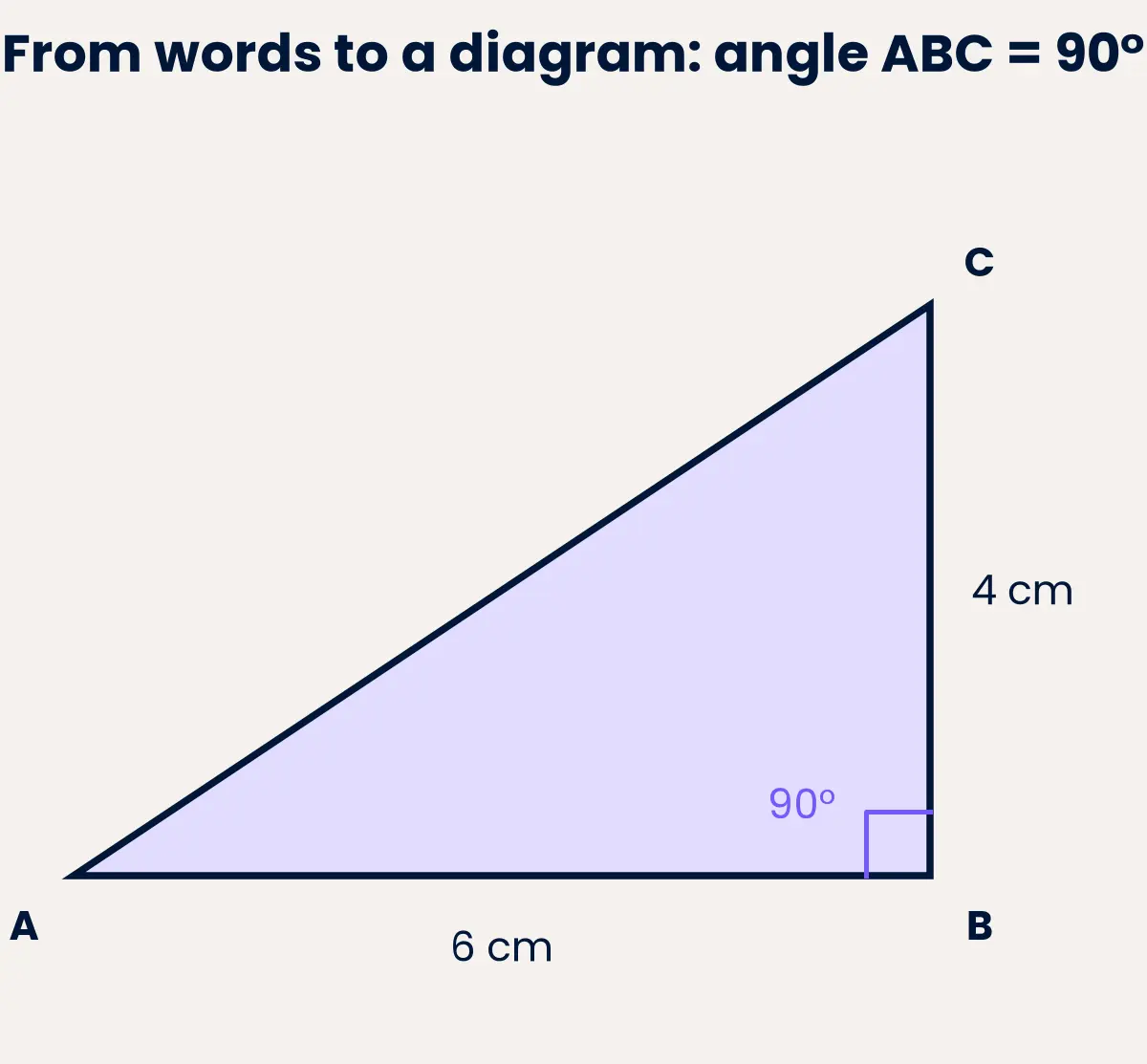
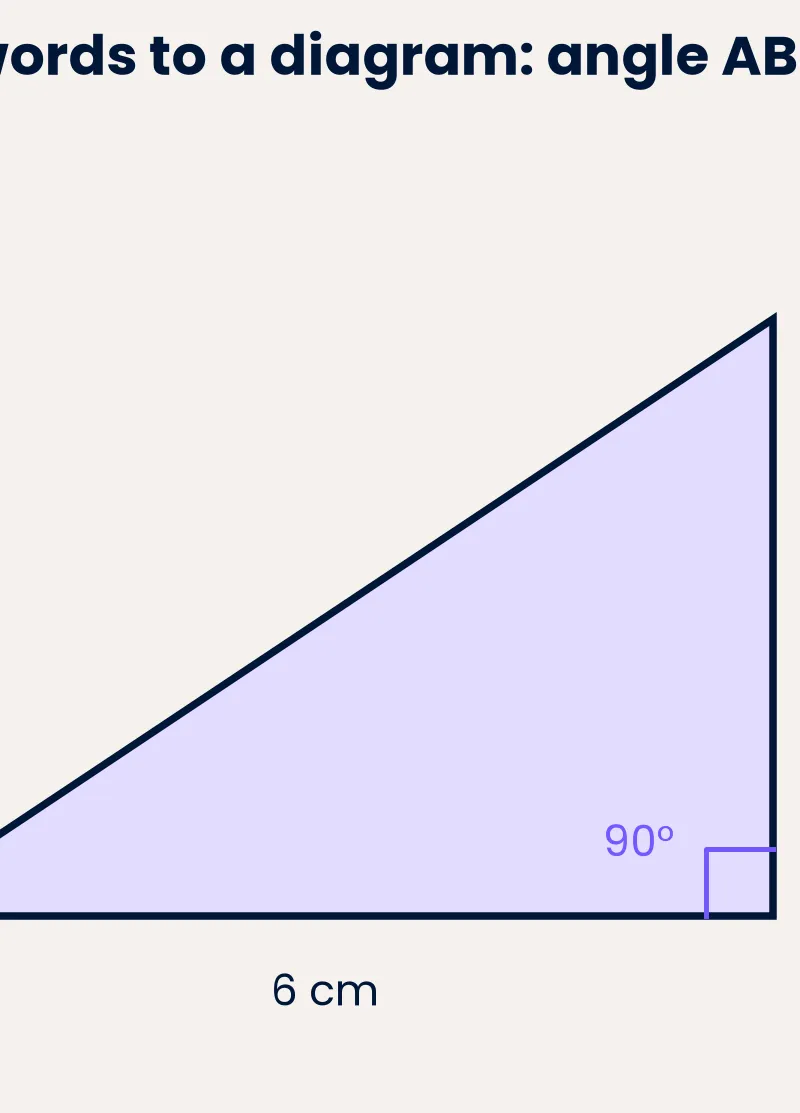
This right triangle has A left, B bottom-right and C above B. AB is labelled 6 cm, BC 4 cm, and the square at B records ∠ABC = 90°. It is a model of communicating facts, not evidence for using Pythagoras unless a question asks for a length.
Mathematical Relationships
Formula status and adjacent angle facts
The core G1 skill is recognising and recording relationships, rather than memorising a large formula list. The angle facts below are adjacent G3 synoptic content, often unlocked by the G1 marks on a diagram. The rotational relationship is symmetry knowledge supporting shape descriptions, not a G3 angle theorem. In the polygon formulae, n is the number of sides, an integer at least 3; order is a dimensionless count. None of these relationships is supplied on the 2026 Foundation formula sheet 3.
| Relationship | Meaning and use | 2026 status |
|---|---|---|
| Right angle = 90°; straight angle = 180°; full turn = 360° | Use a right-angle mark, a straight line or a turn about a point. | Must memorise; not on the 2026 provided sheet 3. |
| Triangle angle sum: A + B + C = 180° | A, B and C denote the three interior angle measures. | Must memorise; not on the 2026 provided sheet 3. |
| Sum of interior angles of an n-sided polygon = (n − 2) × 180° | Use after identifying a polygon with n sides. | Must memorise; not on the 2026 provided sheet 3. |
| Each interior angle of a regular n-gon = ((n − 2) × 180°) ÷ n | Only for a regular polygon. | Must memorise; not on the 2026 provided sheet 3. |
| Sum of exterior angles of a convex polygon = 360° | Use one turning angle at every vertex, taken in the same direction. The familiar positive-angle version applies to convex polygons. | Must memorise; not on the 2026 provided sheet 3. |
| Exterior angle of a regular n-gon = 360° ÷ n | Use only where all exterior angles are equal. | Must memorise; not on the 2026 provided sheet 3. |
| Smallest positive matching rotation θ = 360° ÷ order; order = 360° ÷ θ | θ is measured in degrees; order 1 means θ = 360°. | Must memorise; not on the 2026 provided sheet 3. |
Do not add area, volume, sine-rule or cosine-rule formulae to a G1 answer unless the question calls for their later topics. The 2026 aid provides Pythagoras and right-triangle trigonometry, but not this vocabulary, triangle notation, polygon-angle or symmetry-order material 3. Pearson confirmed that formula sheets continue for the lifetime of the current specification and that the 2026 format is unchanged from 2025 4.
Measurement, Drawing and Exam Context
Use the unit supplied. Useful conversions are 10 mm = 1 cm and 100 cm = 1 m. Write a space between a value and unit, for example 6 cm. If an accurate drawing requests a length to the nearest millimetre, use a ruler carefully; if it requests an angle to the nearest degree, use a protractor correctly. For an accurate drawing, begin at the ruler zero, not its physical edge. Centre the protractor on the named vertex, align its baseline with an angle arm and read the scale that starts at zero on that arm. A scale of 1 cm to 2 m converts a real 6 m length into 3 cm on the diagram. Do not confuse length with area units: 1 cm² = 100 mm², not 10 mm², when you later study area. Coordinate plotting is only relevant when a description gives a vertex position: read (x, y), horizontal first, vertical second, then label the point. A coordinate grid is not evidence for measuring an unscaled sketch. Coordinate methods themselves are G11; statistical graph and data-analysis skills are not part of this G1 topic.
There is no required practical for GCSE Mathematics G1. Treat a drawing task as mathematical communication, not a science practical: apparatus, method and experimental results are not required. Pearson's specification places G1 in Properties and constructions for both tiers 1. Pearson papers are 90 minutes and 80 marks, so the overall rate is 1.125 minutes per mark 1. Aim for roughly one minute per mark on these short practical diagram tasks, then reserve checking time.
Exam Practice and Audio Revision
The authentic context in Pearson Specimen Set 1, Paper 3 Foundation, Question 14 awarded one mark each for marking angle CBA, shading cuboid face CDEG and stating the number of cuboid edges, for three marks total 2. Without reproducing its unavailable figure, learn the lesson: locate each named object exactly, act on it, and do not add irrelevant working. All worked examples and practice questions below are original teacher-written Edexcel-style material with indicative mark schemes. They are not official Pearson questions and their allocations are not fixed Pearson marks.
Listen and pause: after each diagram description, say the vertices in order, name the relationship, then name the conventional mark before revealing the worked solution.
Practical applications
Architects use parallel walls and perpendicular corners in floor plans; packaging designers distinguish faces, edges and vertices; road signs use regular polygons; and technical drawings need unambiguous dimensions. In an examination, use the same professional habit: labels and marks must communicate the specification even if the shape is a quick sketch. A neat diagram lowers the chance of choosing the wrong angle or side in a later G3 calculation. Cover the model diagram and redraw it from its description. Compare the labels and relationships, not the artistic appearance. Repeat the task tomorrow and later in the week so that you retrieve the method instead of merely recognising it.
Official source definitions
Visual Resources
4 diagrams and illustrations
Interactive Diagrams
2 interactive diagrams to visualise key concepts
Conceptual Flow Outline
A mark-safe workflow for creating a diagram from a written description.
Conceptual Flow Outline
The standard correspondence between vertices, opposite side labels and an angle name in triangle ABC.
Worked Examples
3 worked examples — open one to explore the question and available guidance.
Practice Questions
Try the question, then reveal an answer plan or example response
Original teacher-written Edexcel-style consolidation, 2 marks. State whether each sentence is true or false, and correct any false sentence: (a) A face is a corner of a cuboid. (b) Two perpendicular lines meet at 90°.
Hint: Separate three-dimensional vocabulary from angle vocabulary.
Original teacher-written Edexcel-style question, 3 marks. In triangle PQR, write (a) the side opposite P, (b) the side opposite Q, and (c) an angle name whose vertex is R.
Hint: The opposite side is the only side that does not touch the named vertex.
Original teacher-written Edexcel-style question, 4 marks. Sketch quadrilateral WXYZ in cyclic order. WX is parallel to YZ, XY is perpendicular to YZ, WX = 7 cm and XY = 3 cm. Show every fact using conventional marks.
Hint: Draw the closed four-sided outline before adding any labels or marks.
Original teacher-written Edexcel-style consolidation, 3 marks. A regular octagon has rotational symmetry. State its order, calculate its smallest angle of rotation, and state how many reflection lines it has.
Hint: A regular n-gon repeats once for each side during a full turn.
Original teacher-written Edexcel-style adjacent-G3 question, 5 marks. A regular pentagon is drawn with all sides marked equal. (a) Calculate one exterior angle. (b) Calculate one interior angle. (c) Explain why identifying the polygon as regular is essential before dividing 360° by 5 to find one exterior angle.
Hint: Exterior angles sum to 360°. Interior and exterior angles at one vertex sum to 180°.
Original teacher-written Edexcel-style adjacent-G3 reasoning question, 4 marks. Quadrilateral ABCD has AB parallel to CD and AD perpendicular to AB. Prove that angle ADC is 90°, then explain whether ABCD must be a rectangle.
Hint: A line perpendicular to one of two parallel lines is perpendicular to the other.
Exam technique
How to turn what you know into marks
How to approach the question
Decode every noun and relationship before drawing. List shape, vertex order, lengths, angle measures, parallel pairs, perpendicular pairs and equality facts. Draw the closed shape, label vertices cyclically, add measures and conventional marks, then tick each stated condition against the finished diagram. If a later calculation follows, write the relationship that justifies it.
How to structure your answer
For 1 mark, give the exact name, symbol or value. For 2-3 marks, state the requested fact and show the matching notation or one reason. For a multi-mark diagram, make every given fact visible first, then give a calculation with a reason and finish an explanation using the definition, such as the two equality conditions for regular polygons.
Timing
Target roughly 1 minute per mark for a diagram task, then check it. Pearson papers are 90 minutes for 80 marks, an overall ratio of 1.125 minutes per mark, not an official per-question time limit [1].
Common pitfalls
- Putting the vertex at an end of ∠ABC. Avoid it by saying ‘middle means meeting’ before writing the angle.
- Labelling a side a next to A. Avoid it by tracing the side opposite A first.
- Treating a shape as regular because it looks symmetrical. Check both equal sides and equal angles are stated or marked.
- Omitting parallel arrows or the right-angle square. A written length alone does not communicate these relationships.
- Using a symmetry-order recall task as evidence of a predicted isolated G1 question. Use it for consolidation; Pearson guidance says isolated recall is not expected [2].
What the command words want
- Compare
- Use a matched feature: for example, both a rectangle and a general parallelogram have rotational order 2, but only the rectangle has reflection lines.
- Explain
- Link a definition or marked relationship to the conclusion with ‘because’, for example ‘It is not regular because AB and DC are unequal’.
- Describe
- Name what the diagram shows using geometry language: identify the vertices, the parallel pair, or the location of the right angle.
- Evaluate
- This is uncommon for core G1. If asked to evaluate whether a proposed diagram is suitable, test every stated condition: labels, cyclic order, units, parallel marks, perpendicular mark and any equality markings, then make a justified verdict.
- Calculate
- Write the relevant adjacent G3 relationship, substitute the known values, show the arithmetic, and include ° for an angle. Do not calculate before checking whether the polygon is regular.
- Construct
- Use the specified construction method and retain arcs when a ruler-and-compass construction is requested. Formal constructions are G2.
- Mark/Label
- Place the requested letter, angle arc or conventional mark on the correct feature, rather than writing it beside the whole diagram.
- State/Give
- Supply only the precise requested label or value, for example ‘BC’, ‘90°’ or ‘parallel’. Do not replace notation with a vague description.
- Draw/Sketch
- Produce a diagram showing every given fact. A sketch need not be to scale; an accurate drawing must meet the requested measurements.
Watch or listen (optional)
Test your understanding of Geometry and measures - Properties and constructions: use conventional terms and notations: points, lines, vertices, edges, planes, parallel lines, perpendicular lines, right angles, polygons, regular polygons and polygons with reflection and/or rotation symmetries; use the standard conventions for labelling and referring to the sides and angles of triangles; draw diagrams from written description
Active recall beats re-reading. Take an instant quiz now to test what you’ve learned and lock it into long-term memory.
7 days Premium · Then the free plan continues · No card, no charge